A hospital name gives a prototype story a precise place. The PNEUMOSIP third-period report names the paediatric Hospital Niño Jesús in Madrid as the site of a meeting during the project. The detail is useful to an archivist because it identifies an actual contact. Before adding the hospital to a list of clinical study sites, check what the sentence says happened there. CORDIS, PNEUMOSIP, work performed in the third reporting period.
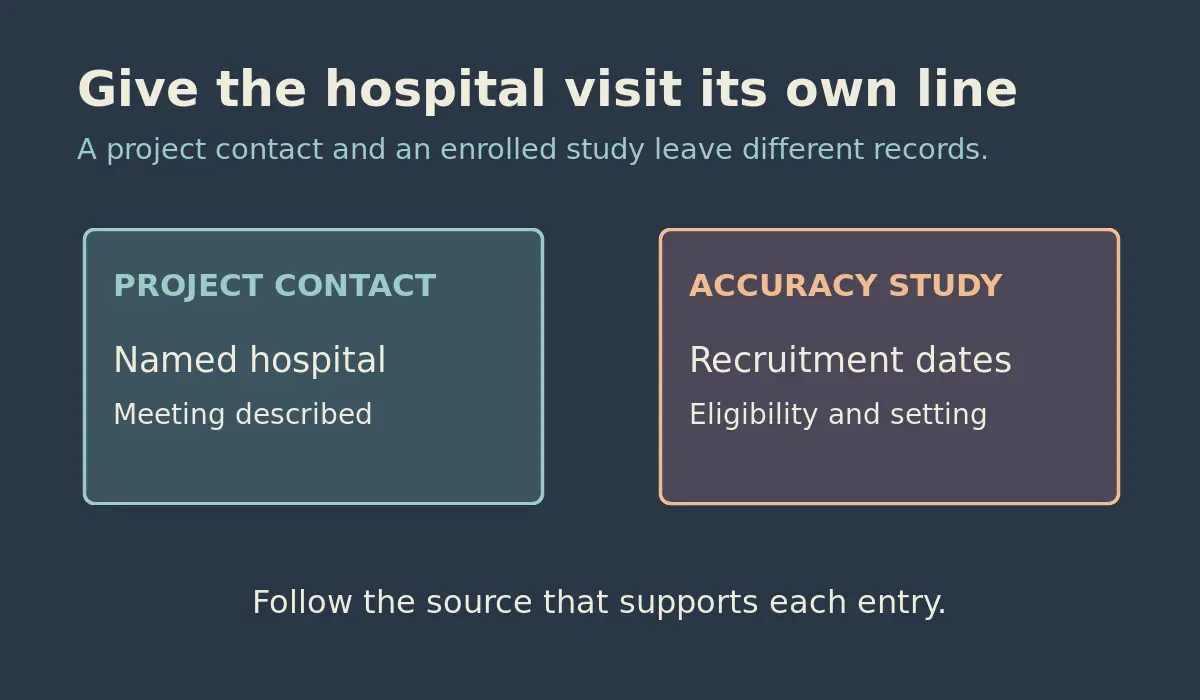
Give the visit its own entry
The summary closes out a reporting period from November 2017 to February 2019. The paragraph puts hospital visits alongside its account of project activity. In a reading note, give the meeting a line of its own carrying the name of the place, the reporting period and a link to the paragraph. The period helps locate the account even though that sentence gives no meeting date. A citation that simply says “PNEUMOSIP at Hospital Niño Jesús” would lose the type of event.
Follow the paper trail for recruitment
When a diagnostic accuracy report names a hospital, a reader can ask how the report links the setting to its participants. The STARD checklist calls for the basis on which potentially eligible participants were identified, where and when they were identified, and how the participant series was formed. Those details make the setting meaningful. A study can recruit at one place, evaluate the test elsewhere and list another hospital because an author works there. The words around the name tell you which link the report documents. STARD 2015, Table 1, items 6–9.
The PNEUMOSIP paragraph supports the contact entry. It gives no recruitment site description or eligibility record for that meeting. If you find a dated study report or registry entry in a later search, check the device identity and dates before drawing a line back to the prototype. Even a matching hospital name would leave the connection open without that link.
A project timeline can therefore record the Madrid contact with confidence and leave the accuracy question unresolved in this source. That is more informative than omitting the visit, and precise enough for someone else to continue the search from the same page.