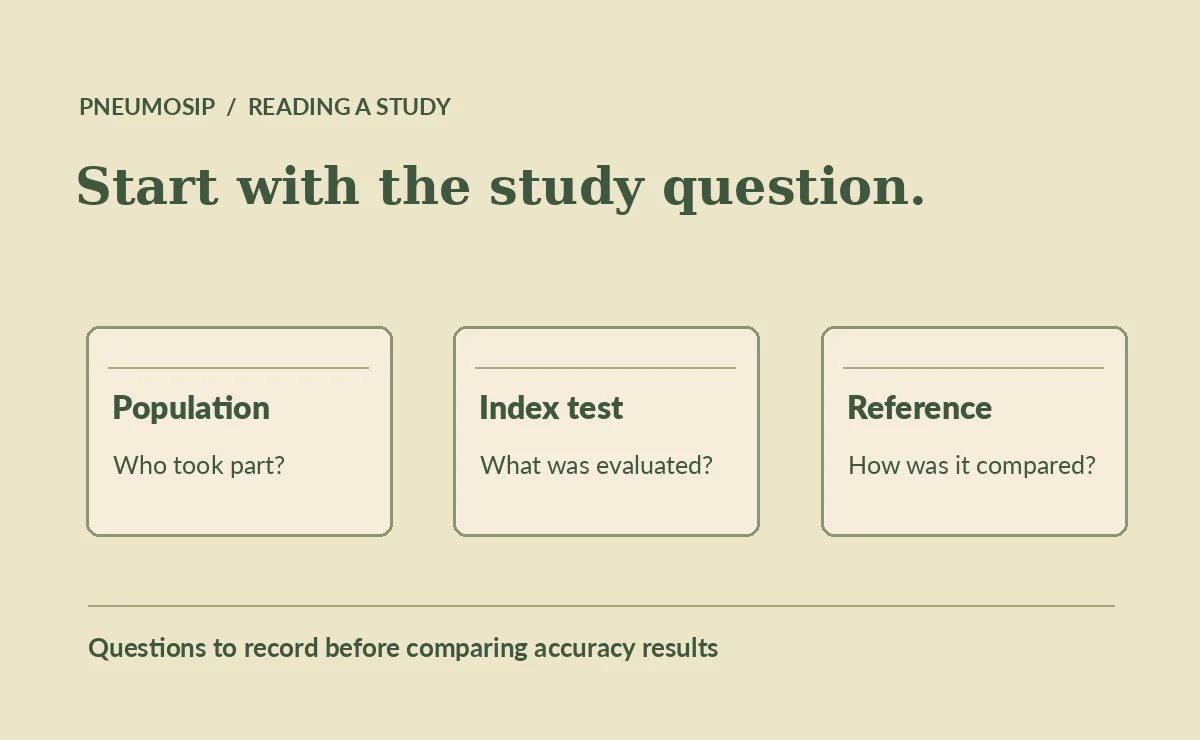
Before comparing diagnostic accuracy numbers, establish what the researchers were trying to distinguish, who took part and how the study determined the condition in those participants. Those details define what the reported result describes.
Read the study question in full
The test being evaluated is commonly called the index test. The reference standard is the method the researchers used to establish the presence or absence of the target condition in the study. A paper should give enough information about both methods to let readers understand the comparison. The STARD reporting checklist also asks authors to describe participant eligibility, how participants were identified and where and when the study was done. STARD 2015 reporting checklist.
Look for the intended role of the test as well. A study of a possible initial test, a follow-up step and a replacement for an existing method can start from different questions. The role helps you read the performance measures in the setting where the authors obtained them.
Two reports can use the same label for different evidence
Imagine a researcher reading two fictional reports about Test A. The first uses archived records from participants whose condition status was already recorded. The second recruits a consecutive group from a defined service during a specified period, then compares Test A with a named reference method. Even if both reports lead with the same accuracy number, the groups and the comparison deserve separate attention.
Start by asking whether the first report describes the way archived records were selected. For the second, look for the participant flow: how many were eligible, who received each test and who entered the analysis. Differences can arise from the way participants were selected, which reference method was used or what happened to missing and inconclusive results. Keep those details beside the stated finding.
Copy four facts into your notes
- Question. Record the target condition and intended research use.
- Participants. Note the eligibility requirements and how participants entered the study.
- Comparison. Record both methods, including the named reference standard.
- Analysis. Check who contributed to the estimate and whether exclusions were explained.
Where a detail is missing, write down what you would need to know before drawing a broader conclusion. An unreadable or missing result is a question for the study report, and the number printed in an abstract cannot resolve it. The STARD explanation discusses participant flow, which people received the reference standard and reasons for incomplete comparison. STARD explanation and elaboration.
The useful outcome is a sentence with a clear scope: “In this study population, the test was compared with this reference method under these conditions.” That sentence gives the next reader enough information to decide whether another report is a meaningful comparison.